
Table of Contents
What Are the NDIS Access Criteria?
1. Age Requirements
2. Residency Requirements
- Australian citizen
- Permanent resident
- Protected Special Category
- Visa holder
3. Disability Requirements
- Communication
- Social interaction
- Learning
- Mobility
- Self-care
- Self-management
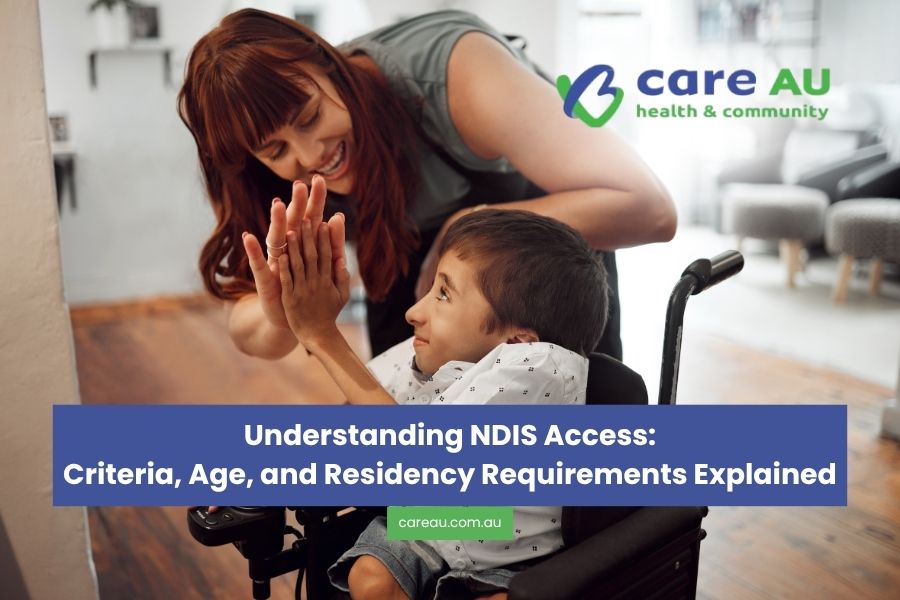
Understanding NDIS Access: Criteria, Age, and Residency Requirements Explained
Understanding the NDIS Age Requirements
- Aged 9 to 64: If you are within this age range, you will apply directly to the National Disability Insurance Agency (NDIA) or be supported by a Local Area Coordinator (LAC).
- Children Under 9: Children younger than nine years old, including those with developmental delay or disability, access the scheme through the Early Childhood Approach (ECA). This pathway is managed by an Early Childhood Partner (ECP) and is often referred to as early intervention. The focus here is to provide support as early as possible to improve long-term outcomes and reduce the need for support later in life.
What Happens If I’m Over 65?
- You will typically access support through My Aged Care. This includes aged care packages and other programs designed for older Australians.
- A Crucial Exception: If you were already an NDIS participant before your 65th birthday, you generally have the choice to remain on the NDIS or transition to My Aged Care. The choice is yours.
NDIS Residency Requirements: Where You Need to Be
- You Must Live in Australia: You need to be currently residing in the country.
- You Must Be One of the Following:
- An Australian Citizen.
- An Australian Permanent Resident.
- A Protected Special Category Visa (SCV) Holder.
Meeting the NDIS Disability Requirements
Defining Permanent and Significant Disability
- Physical
- Intellectual
- Cognitive
- Neurological
- Sensory
- Psychosocial (mental health related)
Life Domain | What it means for NDIS Access |
Communication | Difficulties being understood or understanding others. |
Social Interaction | Difficulties making and keeping friends or interacting in the community. |
Learning | Difficulties acquiring new knowledge and skills. |
Mobility | Difficulties moving around the home, community, or performing physical tasks. |
Self-Care | Difficulties with personal tasks like showering, dressing, and eating. |
Self-Management | Difficulties with problem-solving, planning, decision-making, or managing daily tasks. |
- Diagnostic Reports: It is a formal document of a qualified professional (GPs, specialist, paediatricians or psychiatrists) certifying the diagnosis of the impairment and that the impairment is enduring.
- Functional Assessments: The reports of allied health practitioners specifically stating the effects of the disability on your functional capacity in the six spheres of life. These reports need to be very clear about why your capacity is considerably diminished.
Your NDIS Eligibility Checklist: Are You Ready to Apply?
Requirement | Yes / No |
Age | Were you under 65 on the day you lodged your application? |
Residency | Are you an Australian Citizen, Permanent Resident, or Protected SCV holder living in Australia? |
Permanency | Do you have a permanent impairment (likely to be lifelong)? |
Significance | Does your impairment substantially reduce your capacity in one or more of the six life domains (Communication, Mobility, Self-Care, etc.)? |
Support Need | Do you require ongoing disability-specific supports from the NDIS? (Or, are you seeking early intervention to reduce future need?) |
Taking the Next Step with Care Au
NDIS Access Criteria – Frequently Asked Questions
What does “substantial functional impairment” mean under the NDIS access criteria?
NDIS access criteria substantial functional impairment means that your permanent disability significantly reduces your ability to perform everyday activities in one or more of six key life domains: Communication, Social Interaction, Learning, Mobility, Self-Care, and Self-Management. “Substantial” means more than occasional difficulty — it means you are unable to perform the activity safely or reliably without disability-specific support, assistive technology, or environmental modifications.
How does the NDIA decide if my impairment is substantial?
The NDIA relies entirely on the evidence submitted with your access request. Assessors review reports from health professionals describing what you can and cannot do, how long tasks take, risks involved, and what supports are required. Functional assessments from occupational therapists are often the strongest evidence.
Do I need to be impaired in multiple life domains to qualify?
No. You only need substantial functional impairment in at least one of the six life domains. However, evidence across multiple domains may lead to a broader NDIS support plan.
Can I apply for the NDIS if my condition fluctuates?
Yes. The NDIA assesses your overall functional capacity over time. If you require ongoing disability-specific support even during better periods, you may still meet the access criteria.
What is the most common reason NDIS access applications are rejected?
The most common reason is insufficient evidence describing functional limitations. Applications that only mention a diagnosis without explaining daily impacts often fail to meet the NDIS threshold.
What evidence do I need to demonstrate substantial functional impairment?
Strong evidence includes a confirmed diagnosis from a GP or specialist, a functional capacity assessment from an occupational therapist, and reports from allied health professionals describing daily support needs.
Can I re-apply if my NDIS access request is rejected?
Yes. You can request an internal NDIA review. If the decision remains unchanged, you can appeal through the Administrative Appeals Tribunal (AAT). Many applicants succeed once stronger evidence is submitted.
Does the NDIS cover children under 9 years old?
Yes. Children under nine access support through the Early Childhood Approach, which focuses on early intervention delivered by Early Childhood Partners.
How long does the NDIS access decision take?
The NDIA aims to make access decisions within 21 days after receiving all required information. If further evidence is requested, the process may take longer.
Need help getting started? Contact Care Au today. We’re happy to guide you through the process.